
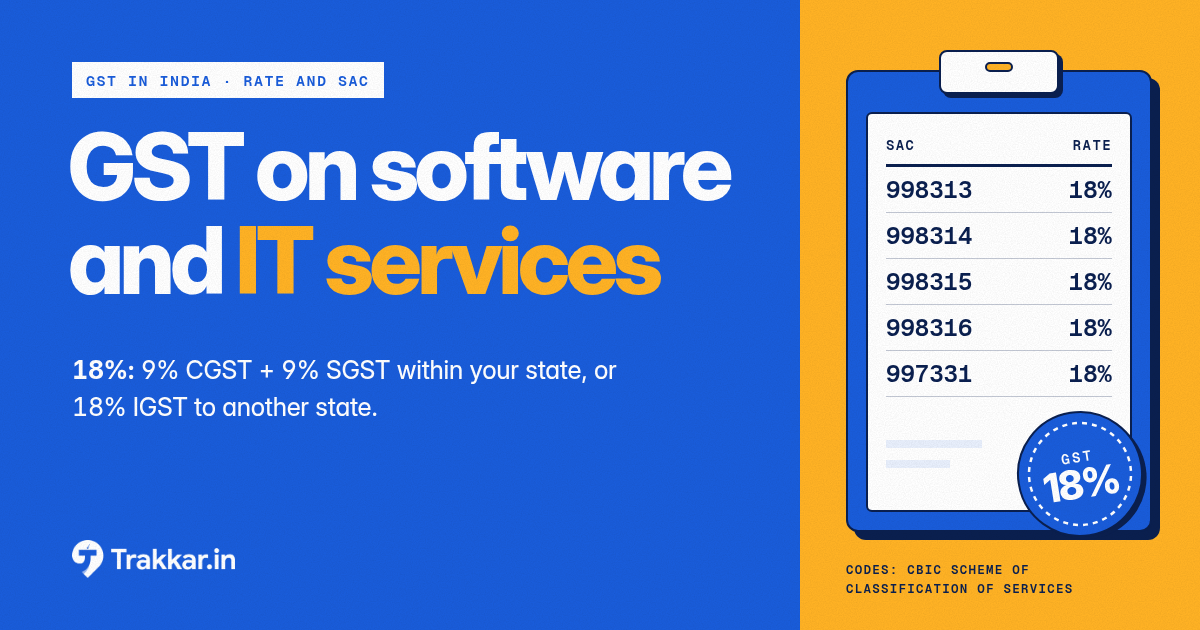
GST on software and IT services in India is 18%: 9% CGST plus 9% SGST when your client is in your state, or 18% IGST when the client is in another state. The GST rate overhaul that took effect on 22 September 2025 left it as it was. Exports of IT services are zero-rated, and a registered business buying software services from abroad usually pays the IGST itself under reverse charge.
This is general information, not tax advice. Check your case with a chartered accountant. Every rate and rule below links to the notification, Act or official government document it comes from, as read on 29 October 2026.
GST rate and SAC codes for software and IT services
Each service falls under a Services Accounting Code (SAC). The codes below are from the Scheme of Classification of Services, and the rates are from Notification 11/2017-Central Tax (Rate) for services and Notification 9/2025-Central Tax (Rate) for goods.
| Code | What it covers | GST rate |
|---|---|---|
| SAC 998313 | Information technology consulting and support services | 18% |
| SAC 998314 | Information technology design and development services | 18% |
| SAC 998315 | Hosting and information technology infrastructure provisioning services | 18% |
| SAC 998316 | Information technology infrastructure and network management services | 18% |
| SAC 998319 | Other information technology services nowhere else classified | 18% |
| SAC 997331 | Licensing services for the right to use computer software and databases | 18% |
| HSN 8523 | Pre-developed software supplied on a medium or through encryption keys (goods) | 18% |
Where the 18% comes from. Notification 11/2017-Central Tax (Rate) lists heading 9983, "other professional, technical and business services", at 9% CGST (serial number 21, item (ii)). It lists the "temporary or permanent transfer or permitting the use or enjoyment of Intellectual Property (IP) right in respect of Information Technology software" under heading 9973 at 9% CGST too (serial number 17, item (ii)). SGST matches CGST, so a sale within your state carries 9% + 9%, and IGST on a sale to another state is 18%.
What about SaaS? The scheme has no SAC that names SaaS. Use 998315, hosting and information technology infrastructure provisioning services, when the contract is mainly for hosting or infrastructure the client uses. Use 997331, licensing services for the right to use computer software and databases, when the contract is mainly a license to use the software. Confirm the choice with your CA. Both are at 18%.
How many digits to show. Notification 78/2020-Central Tax sets the number of code digits by aggregate turnover in the previous financial year. Up to ₹5 crore, a 4-digit code is mandatory on B2B invoices (to registered clients) and optional on B2C invoices (to unregistered clients). Above ₹5 crore, a 6-digit code is mandatory. CBIC's press release on HSN and SAC codes confirms that the rule covers SAC on services invoices. Our guide to the GST invoice format for services covers the rest of the invoice.
Is software goods or services?
Mostly services. Schedule II of the CGST Act treats two things as a supply of services:
- "development, design, programming, customization, adaptation, upgradation, enhancement, implementation of information technology software" (paragraph 5(d))
- "temporary transfer or permitting the use or enjoyment of any intellectual property right" (paragraph 5(c))
The exception is packaged software. This point comes from a 2017 CBIC FAQ, not from the Act or a rate notification. That IT and ITES FAQ says that if "a pre-developed or pre-designed software is supplied in any medium/storage (commonly bought off-the-shelf) or made available through the use of encryption keys, the same is treated as a supply of goods classifiable under heading 8523." Heading 8523 sits in Schedule II of Notification 9/2025-Central Tax (Rate), at 9% CGST, so it is 18% as well.
The difference matters even when the rate is the same. Goods and services follow different place of supply rules, so the classification can decide whether you charge CGST + SGST or IGST.
What changed on 22 September 2025
For IT and software services, nothing changed.
The 56th GST Council meeting on 3 September 2025, as summarized in the Government's PIB press release, moved GST to "a 2 rate structure with a Standard Rate of 18% and a Merit Rate of 5%", plus a 40% rate for a few goods and services. It set the new service rates to apply from 22 September 2025. The services on its rate change list include hotel stays, beauty services, transport and job work. Under heading 9983, the only change listed is for professional, technical and business services "relating to exploration, mining or drilling of petroleum crude or natural gas or both", which moved from 12% to 18%. IT and software services are not on the list.
Notification 15/2025-Central Tax (Rate) (e-Gazette copy), in force from 22 September 2025, is the primary source: it put those changes into law. For heading 9983, it rewords item (ii) to read "Other professional, technical and business services other than (i) above and serial number 38 below" and leaves the 9% CGST rate as it was. It does not touch serial number 17, the software license entry.
On the goods side, Notification 9/2025-Central Tax (Rate) replaced the old goods rate notification from the same date. Heading 8523 is in its Schedule II, the 9% CGST schedule, so packaged software stays at 18%.
Exporting software and IT services
Section 16 of the IGST Act calls the export of services a zero-rated supply. You have two routes:
- Under a Letter of Undertaking (LUT), without paying IGST. You then claim a refund of the input tax credit you could not use (section 16(3)).
- Paying IGST and claiming it back. Section 16(4) lets the Government name who can take this route. Notification 01/2023-Integrated Tax, as amended by Notification 05/2023-Integrated Tax, allows all services and excludes only certain goods.
A service only counts as an export when it meets all five conditions in section 2(6) of the IGST Act, including payment in convertible foreign exchange or in rupees where RBI permits. Our guide to GST invoices for export of services under LUT walks through the conditions, the LUT and the invoice wording.
Buying software and SaaS from abroad
Reverse charge for registered businesses. Section 5(3) of the IGST Act lets the Government move the tax to the recipient. Notification 10/2017-Integrated Tax (Rate) does that for "any service supplied by any person who is located in a non-taxable territory to any person other than non-taxable online recipient." So when your business in India subscribes to software from a supplier outside India, you pay the IGST yourself under reverse charge.
Online services to consumers. The IGST Act calls these "online information and database access or retrieval services" (OIDAR). The definition in section 2(17) includes "providing cloud services", "provision of e-books, movie, music, software and other intangibles through telecommunication networks or internet" and "digital data storage". A "non-taxable online recipient" is an unregistered person in India receiving such services (section 2(16)). For those sales, section 14 makes the foreign supplier liable to pay the IGST, through a single registration under a simplified scheme.
Place of supply. When the supplier or the recipient is outside India, the place of supply of most services is the location of the recipient (section 13(2)). For OIDAR it is also the recipient's location, worked out from details such as the billing address, the card used and the IP address (section 13(12)).
E-invoicing from 1 January 2027. Notification 04/2026-Central Tax adds "import of services" and reverse charge supplies from unregistered persons to the e-invoicing scope from 1 January 2027. It adds to what must be e-invoiced and leaves the turnover limit as it is, so it matters only if you already have to e-invoice. Ask your CA how it applies to your imported software.
Getting the invoice right
Before you send a software or IT services invoice, check:
- The SAC that matches the service, with 4 or 6 digits depending on your turnover and, up to ₹5 crore, on whether the client is registered.
- The rate: 18%, split as 9% CGST + 9% SGST within your state, or 18% IGST to another state.
- The place of supply, with the state name for supplies to another state.
- The client's GSTIN for a registered client.
- For exports, the LUT or IGST-paid wording, and no CGST or SGST.
Trakkar creates GST invoices with your client's GSTIN, one tax rate per invoice, and invoice numbers that restart each Indian financial year on 1 April. It doesn't add SAC codes or place of supply, and it doesn't split CGST, SGST and IGST, so check those against your CA's advice. Trakkar doesn't file GST returns or generate e-invoice IRNs. For a ready layout, use our free GST invoice template.
Rates and rules here were checked against the Acts, notifications, CBIC documents and Government press releases linked above on 29 October 2026. GST rules change often. Check your case with a chartered accountant before you invoice.